Inspired by the visionary founders of our industry
Committed to today’s innovators and those who read them
The earliest breakthroughs in personal computing were enabled by the 8080 microprocessor and the people devoted to making great software. We’re excited to publish insights, ideas, and research that empower people and organizations. That’s why we’ve launched a book imprint to help advance technology, science, and business.


©2026 8080 Books, an imprint of Microsoft
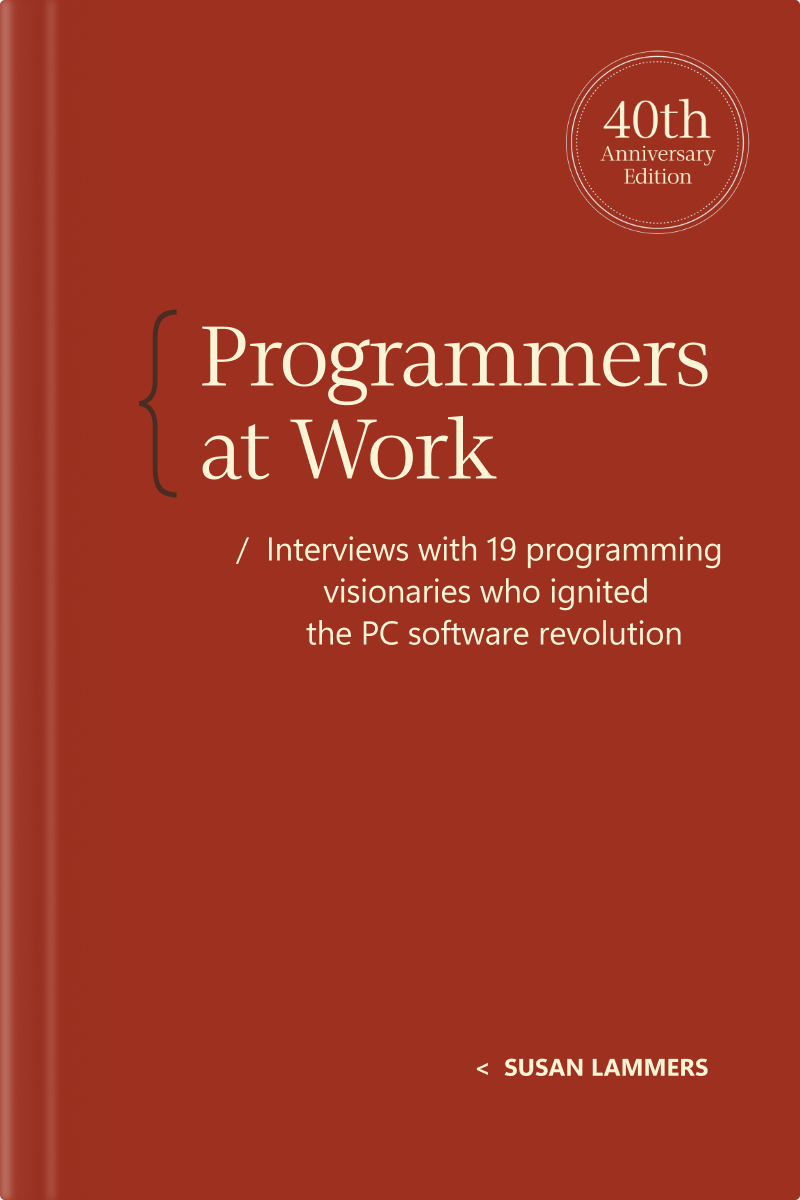
Programmers at Work, originally published to wide acclaim in 1986, is a “world of ideas” book that has renewed relevance today for software engineers and programmers working in the new software revolution shaped by AI, LLM, and robotics. This collection of candid, in-depth interviews probes the minds and life stories of 19 notable programmers such as Bill Gates, Charles Simonyi, Dan Bricklin, Andy Hertzfeld, John Warnock, Jaron Lanier, Toru Iwatani and others who launched an industry. The interviews highlight the forces, the events, and the personalities that influenced their work and launched a revolution. How did these programmers approach program design? Is programming a talent or a learned skill? And how did these programmers envision the future of computing?
My job title was “Computer”. Other people have programmed computers, but I have been one.
Each interview reveals an individual success story, and the collection taken as a whole is a colorful portrait of the birth of the PC industry. Today so many new things can be done with computers, but often great new ideas come from recombining old ideas in new ways. This book offers fertile ground for programmers who are reimagining what software can do and creating fresh solutions and products in the field of robotics, AI, and consumer software. Grounded in the track record of history, these programmers reveal their personal stories of pursuing out of the box thinking, building products through trial and error, the coding secrets to their historic breakthroughs, and the obstacles they overcame in their quests. The conversations offer an inspirational roadmap for software designers and programmers creating products today.
Susan Lammers

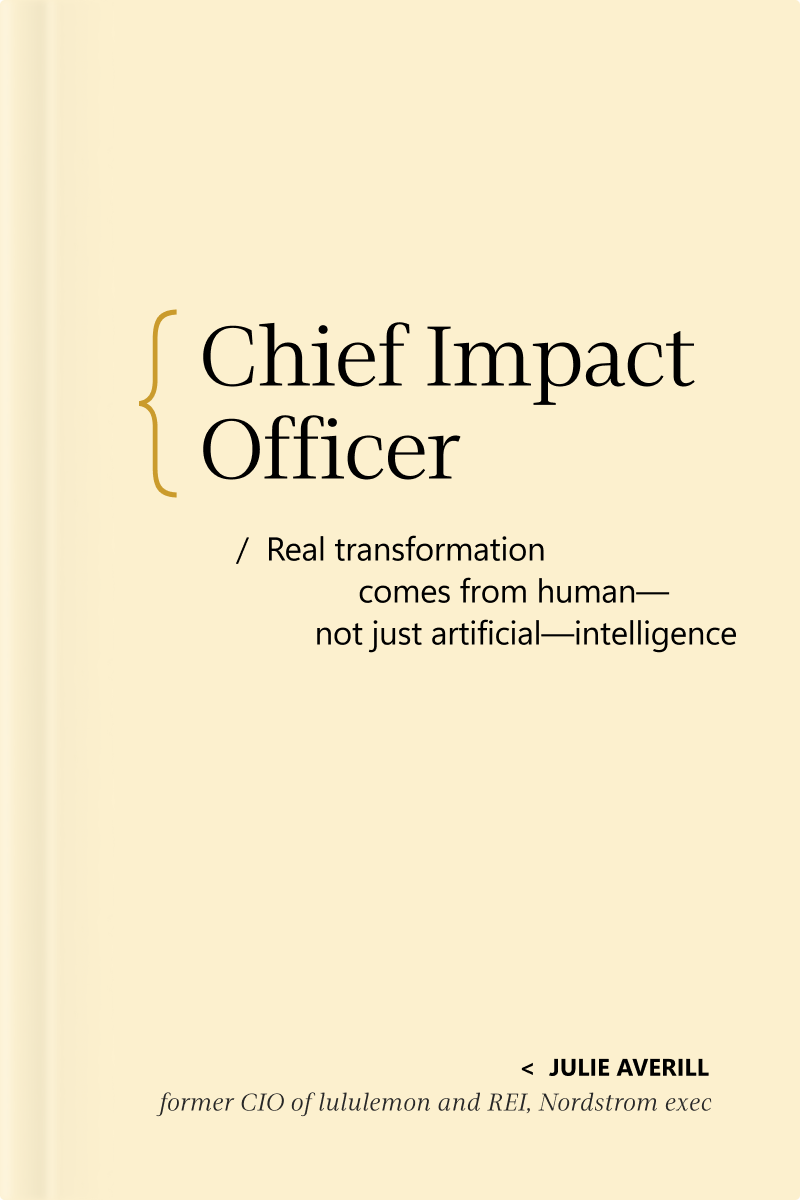
As Chief Information Officer of lululemon, Julie Averill led the technology transformation that helped scale the company from $2 billion to over $10 billion in revenue while building global teams capable of sustaining that growth. Prior to lululemon, she led omni-channel and digital transformations at Nordstrom and REI, navigating system failures, high-stakes crises, and the complicated work of integrating technology with business strategy at scale.
If you don’t understand why someone shuts down during conflict, or works themselves into the ground, or can’t take feedback without spiraling, you’re missing half the story. And if you don’t understand your own patterns—the ways your past shows up in how you lead—you’ll keep hitting the same walls.
Julie spent her career navigating systems that weren’t designed for her—and helped change them along the way. A female leader in technology. A gay woman in rooms where difference still raises eyebrows. A mother who carried two and adopted one child while leading global technology organizations. And a Chief Information Officer who believes the future of AI depends less on machines and more on how human we’re willing to be.
Today, she advises boards, CEOs, and founders at the intersection of AI capability and organizational readiness—the place where most transformations stall. She speaks globally on leadership in the age of AI and helps organizations build what technology can’t deliver: teams that tell the truth, leaders who can turn pilots into real change, and cultures that sustain transformation instead of performing it.
After years in corporations proving herself, building teams, and transforming companies, Julie learned that what matters most is not the systems you build or the revenue you generate, but the people whose capabilities you unlock, the leaders who become more than they thought possible, and the ripple effects that continue long after you’re gone.
She lives in Bellevue, Washington, with her wife Cindy and their three children. When not speaking, advising, or writing, she’s on the pickleball court, traveling to visit family across continents, or learning from her global family that the most profound transformations happen when we expand who we’re willing to become.
Julie Averill

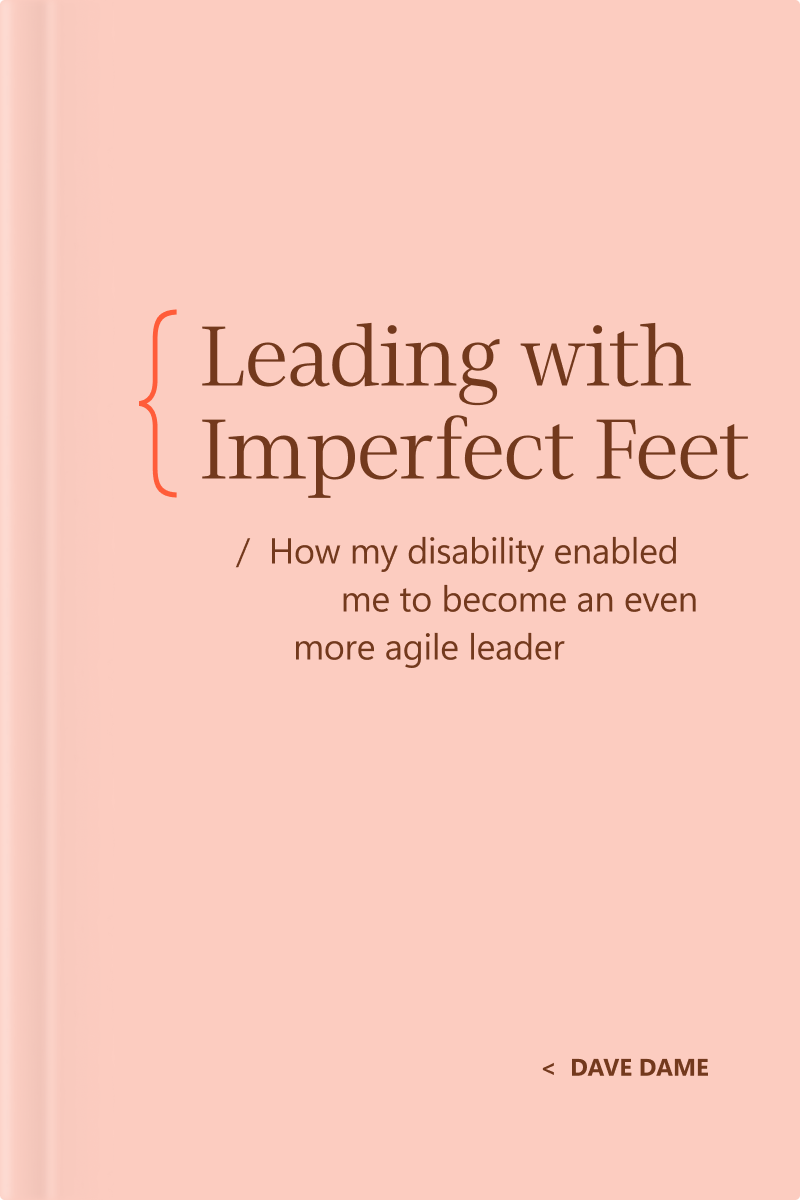
Leading with Imperfect Feet is a revelation in modern leadership thinking, told through the lived experience of someone who has navigated change his entire life. Born with cerebral palsy, David Dame learned early that progress comes not from waiting for perfect conditions, but from taking imperfect steps, adapting continuously, and welcoming discomfort as the price of growth.
This is not a leadership book about playing it safe. It’s a call to lead from discomfort, trust your people, and move forward before you feel ready. Honest. Practical. Necessary.
Drawing from decades leading enterprise transformation, building inclusive products, and coaching executives around the world, David offers a refreshing and deeply human approach to leadership. Through powerful storytelling—from learning to walk into the ocean for the first time to redesigning work systems from the bottom up—he illustrates how vulnerability, curiosity, grit, and openness are not soft skills, but the foundation of high-performing organizations.
The book blends personal narrative with actionable leadership insight, demonstrating how embracing flaws, failures, and experimentation enables teams to innovate faster and work with purpose. Using memorable stories like going three years without a washroom break at his first job, hiring his first personal support worker at eighteen, and reshaping product design at Microsoft, David shows why real change starts with seeing barriers as opportunities and people as whole humans.
Perfect for leaders, product makers, change agents, and anyone who wants to build more inclusive and adaptive organizations, Leading with Imperfect Feet challenges readers to rethink what strong leadership looks like—and to realize that their imperfections may be their greatest competitive advantage.
David Dame

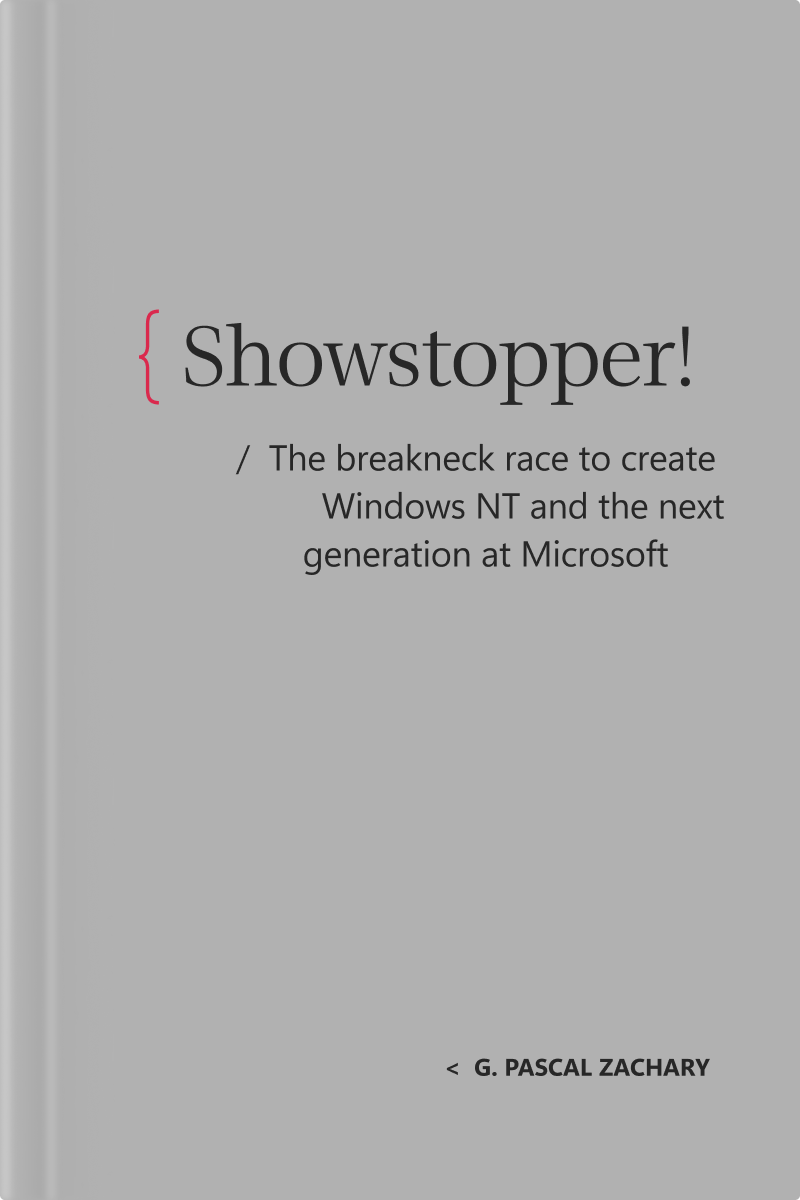
Showstopper! is the dramatic, inside story of the creation of Windows NT, told by Wall Street Journal reporter G. Pascal Zachary. Driven by the legendary David Cutler, a picked band of software engineers sacrifices almost everything in their lives to build a new, stable, operating system aimed at giving Microsoft a platform for growth through the next decade of development in the computing business.
Shipping was perhaps the only true measure of a programmer’s craft. ‘If you don’t finish, Cutler said, ‘all the bright ideas don’t mean anything.’
Comparable in many ways to the Pulitzer Prize-winning book The Soul of a New Machine by Tracy Kidder, Showstopper! gets deep inside the process of software development, the lives and motivations of coders and the pressure to succeed coupled with the drive for originality and perfection that can pull a diverse team together to create a program consisting of many hundreds of thousands of lines of code.
G. Pascal Zachary

Hyderabad Days is a tender, evocative memoir that journeys from colony lanes to corner offices—a world where barefoot cricket, bajjis, fan letters to TV goddesses, and jamun-stained summers quietly shaped a future engineer and executive.
In these richly drawn vignettes, Ravi invites readers into a childhood filled with warmth, wit, and wisdomand shows how even in the most high-powered situations, the lessons of a streetlamp study session, or a colony cricket match still echo.
Before I was an executive, I was an engineer. Before I was an engineer, I was simply a boy in a Hyderabad colony, learning the code of community: share your snacks, play fair in cricket, stretch every rupee, and respect your elders. Those lessons became my first algorithms. Street cricket was our operating system. Jugaad was our debugging tool. Friendship was the best program we ever wrote.
Ravi Vedula

The most important concept we want students to learn is to think creatively to solve complex problems. Computer programming is just a tool to systematize problem solving.
I am a computer scientist, but I am a human first. A human who has daughters, to whom I’ve dedicated this book, and who wants to build a better world for them and for future generations.
I care deeply about both technology and people, and as a result, how they intersect and impact one another. That’s the first big idea of this book: human agency, which is our greatest tool to shape the impact of technology in our lives.
Humans should understand technology. Evaluate it. Use it, if it is empowering, and not use it, if it is harmful. This concept is based on the definition of machine usefulness (MU) from MIT economists and Nobel laureates Daron Acemoglu and Simon Johnson’s insightful book Power and Progress. More important than being intelligent, efficient, or anything else, computer systems should above all enhance the human experience.
Marcus Fontoura

WorkLab is the inside story of how work was reinvented—first by necessity, then by design. As the world’s routines were upended in 2020, Microsoft’s customers, researchers, and product makers found themselves at the center of a global experiment in how we work. To capture this transformation in real time, WorkLab was founded as a digital publication dedicated to original research and insights on the future of work.
This anthology brings together five years of WorkLab’s most compelling data, insights, and stories. Drawing on Microsoft’s world-class research, it chronicles the sudden move to remote work, the rise of hybrid models, and the dawn of AI-powered transformation.
It offers a time capsule of practical wisdom for anyone navigating the new world of work—whether you’re a solopreneur, a team leader, or a CEO. It’s a testament to resilience, adaptability, and the power of scientific thinking to guide us through uncertainty.
As technology accelerates change, WorkLab invites you to look ahead with optimism and curiosity. The future of work is being written every day—and it starts with each of us.
This anthology is a testament to the resilience of the human spirit. It’s an homage to the individuals, leaders, and organizations that keep adapting and creating and innovating as our ideas about work continue to change.
Colette Stallbaumer

Jaime Teevan
Marcus Fontoura’s career, and indeed this book, has largely been about the ethos needed to build powerful platforms.
A tech platform is a reusable system that implements a core piece of functionality, such as identity. In this case, an identity platform provides a solution for users to log-in to multiple services. Developers gain agility when using platforms, as they don’t need to implement the whole system from scratch and can focus on the new, differentiating innovations.
A platform, however, is an external dependency. Thus, using a platform implies teams taking a dependency on other teams. This requires coordination and collaboration. It is impossible to build the large-scale, complex systems of today without relying on platforms and their multiplier effect to build a scalable identity solution once and reuse it many times in all the company’s services. This means that modern technology organizations need to be highly collaborative, with all their sub teams interacting in an open way, in which ideas are generated, developed, and propagated in an environment that empowers the developers to be themselves and let their creativity flourish.
The mix of worldviews, backgrounds, personal experiences, and diverse cultural histories within companies is one of the secret ingredients for the emergence of truly innovative solutions.
Platforms are the seeds of innovation and require their daily dose of creativity and collaboration to blossom into the systems that impact our lives and society in a positive way. Fontoura truly believes we can create a better world through technology and a platform mindset is the foundation.
Marcus Fontoura
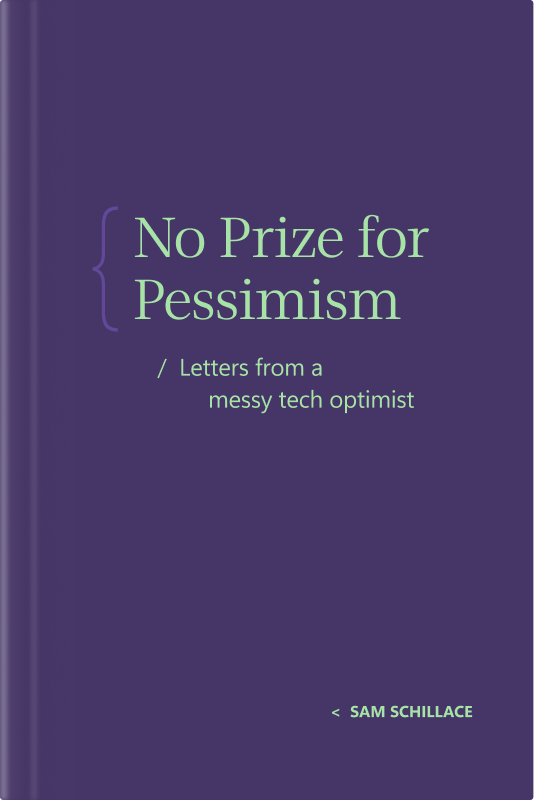
No Prize for Pessimism by Sam Schillace is a thoughtful meditation on the importance of optimism in building and designing tech products—or any product, for that matter. Schillace is Microsoft’s Deputy Chief Technology Officer. He is the co-inventor of Google Docs, a product used by more than a billion people around the world.
Through a series of insightful letters and reflections, Schillace shares his journey from the early days of personal computing to the forefront of AI innovation. This book delves into the mindset required for disruption and innovation, emphasizing the importance of optimism, experimentation, and a willingness to embrace the messiness of creation.
In his debut as an author, Schillace argues that optimism is crucial for innovation, contrasting it with the dangers of a pessimistic mindset which he believes stifles creativity and progress. Leadership, according to Schillace, is rooted in humility and trust. He warns against the “prima donna death spiral” where leaders fail to delegate, leading to team inefficiency. The author discusses the transformative potential of AI, emphasizing the need to integrate AI capabilities with traditional coding practices for effective product development. He explores the balance between speed and maintainability in coding, advocating for a pragmatic approach to software development. Schillace stresses the importance of humility in leadership, encouraging leaders to support their teams and prioritize collective success over personal ego. He identifies several emerging technologies with disruptive potential, including AI, quantum computing, and renewable energy solutions. Throughout, the author encourages readers to adopt a “What if?” mindset, fostering creativity and resilience in the face of challenges.
Let your ‘what if’ questions drive you—the next great idea could be yours and it could change the world.
Schillace shares personal anecdotes and lessons learned throughout his career, offering practical advice for aspiring innovators and leaders. No Prize for Pessimism is perfect for entrepreneurs, engineers, and anyone interested in the future of technology.
Sam Schillace

8080 Books
Why a book imprint?
Books matter. In a deluge of data. In a bloat of blogs, a sea of social, and a maelstrom of email. Books will always matter.
They matter more than ever, especially when they can be produced and distributed more quickly than traditional publishing. They offer human intimacy at scale. That’s what happens when a writer speaks directly to a reader on the page.
They impart very precise knowledge and wisdom. Books build empathy. That’s what happens when a writer has the time and space to choose exactly the right word and phrase to communicate an idea. It’s what happens when a reader truly connects with a writer. We are especially interested in new and nontraditional writers and thinkers at 8080 Books.
Computing has become an essential ingredient in almost every endeavor on our planet. As students both of Microsoft and technology, our goal with 8080 Books is to publish original research, ideas, and insights at the intersection of science, technology, and business, and in doing so, help advance the discourse and debate. Our initial focus for titles includes: technology and the future; business process and productivity, and societal priorities in law, ethics, and policy.
Creating, building, and sustaining an idea or argument over tens of thousands of words while holding a reader’s interest is not the same as dashing off an email, a post, a video, or even a speech. A book anticipates counterarguments, skepticism, and is unafraid of calling bullshit on the current take of the day. Books require a different writer—and a different reader—than short-form. Books offer permanence and substance for future scholars, educators, and historians – to capture a moment in time.
This has been true for as long as humans have written, first for a handful of readers and later for millions. Technologies have always been an instigator. The invention of the mechanical clock led to the invention of time-based musical notation, which hastened the spread of music and musical innovations. The printing press led to the proliferation of printed products like books.
Technologies change the philosophical discourse. Telephones, televisions and the internet did that. And now AI is doing that. The Industrial Revolution came hand in hand with the Enlightenment. Subsequent technological revolutions required revisiting philosophical and ethical principles.
We aim to bring forward great content. But we also seek to accelerate the publishing process shortening the lag between the final manuscript and the book’s arrival in the marketplace. We seek to hasten the diffusion of knowledge. We are impatient and time sensitive. Technology has quickened the pace of almost every industry except publishing. This means that book-sized writing about tech transformations arrives after conventional wisdom has begun to gel. We don’t have all of the answers, but we know that more important ideas and arguments can travel faster than they do at the moment. Can they travel too fast? Of course, that already happens in abundance, but we seek to strike the right balance.
We plan to test and experiment with the latest tech to accelerate and democratize book publishing. We are customer-zero for Microsoft tech. We are building a rigorous editorial process: spot meritorious ideas and arguments fast, often from nontraditional authors, assist with manuscript development, invite internal and external reviews, live up to style and substance standards, and use the latest tech to assist in doing these things. Financially we will cover the costs of utilizing publishing professionals and donate the remaining revenue to nonprofits through Microsoft Philanthropies. Relevant books service our corporate mission.
Anyone and everyone are future readers and writers. That said, we anticipate that many of our readers and writers will come from these places: current, former, and future Microsofties, customers and partners, researchers, and policymakers.
We don’t pretend to be independent, but we recognize the importance of interdependence in our company, community, ecosystem, and economy. As such we value the freedom, purpose, and education of our authors and readers.
In many cases, our publishing will be an alternative to larger publishers with less focus. We will also seek to re-issue significant works and out-of-print books that are relevant to our communities.
Microsoft’s love for books dates to its earliest days. We’ve long maintained a professional library that every employee can access. Microsoft Encarta was one of the first digital books. And Microsoft Press has published quality instructional books for generations. Our road ahead is to identify leading-edge voices, ideas, trends, needs and, yes, concerns to inform our very deep and very wide readership across all industries and sectors.
We’d like to hear from you. What have we missed or overlooked in our charter for 8080 Books? Email us at [email protected].
Greg Shaw, Editor
Steve Clayton, Publisher